







10 Most Common Errors in Particle Analysis - And How to Avoid Them
Particle analysis is an integral part of the quality control of bulk materials and is routinely performed in numerous laboratories. The methods used have often been established for years and are hardly ever questioned. Nevertheless, the procedure should be critically reviewed from time to time because a whole series of sources of error can negatively influence the results of a particle analysis. This white paper is intended to provide food for thought to make methods for particle characterization more reliable and accurate.

A Conceptual, Non-Mathematical Explanation on the Use of Refractive Index in Laser Particle Size Measurement
An explanation of Mie scattering and how Microtrac laser diffraction analyzers evaluate scattering signal from small particles.
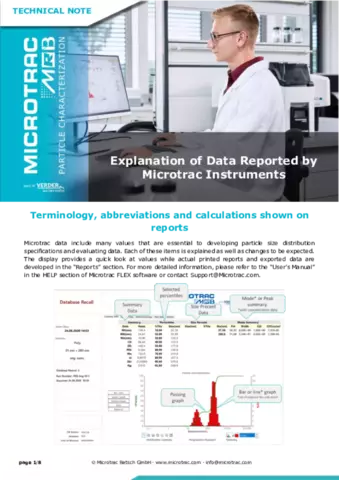
Explanation of Data Reported by Microtrac Instruments
A document explaining the various result data presented in the Microtrac Flex Software, e. g. percentiles, tabular data, mean values etc.


White Paper: Correlation between sieve analysis and image analysis made easy
Dynamic Image Analysis (DIA) has become a widely used method for routineanalysis of particle size and particle shape in many industries. In this white paper we explain how traditional sieve analysis can successfully be replaced by DIA. The results produced by both techniques can be made to match so that product specifications based on sieve analysis remain unchanged. Users of image analysis benefit from reduced workload, higher sample throughput and more detailed results.

Whitepaper - Why zeta potential, particle size and stability must be measured together?

Partikelgröße und Zetapotential von Tinten messen
Tinten für Farbdrucker sind Suspensionen aus zahlreichen Komponenten, deren Partikelgrößen auch die Eignung als Druckertinte, die Tintenqualität und das Druckergebnis beeinflussen. Auch die Informationen zu Partikelgrößenverteilung und Zetapotential sind hilfreich zur Beurteilung der Qualität von Drucktinten in Bezug auf das zu erwartende Druckergebnis.