






Dynamic Image Analysis (DIA) is a modern particle characterization method for the determination of size distributions and shape parameters. It allows quick analyses with excellent accuracy and reproducibility over an extremely wide measuring range. With the renowned CAMSIZER system, Microtrac introduced its first Dynamic Image Analyzer over 20 years ago and has pushed technological innovation ever since.
- Meetbereik: 0.9 µm - 8 mm
- Droge en natte analyse van poeders en suspensies

Background information on the functional principle, advantages and usage of Dynamic Image Analysis

- Meetbereik: 20 µm - 30 mm
- Droge analyse van granulaten en stortgoederen

- Meetbereik: 30 µm - 5 mm
- Droge analyse van granulaten en stortgoederen

- Meetbereik: 160 µm - 135 mm
- {{LL::product.camsizer-xl.features}

- Meetbereik: 30 µm - 30 mm (ONLINE) / 160 µm - 135 mm (ONLINE XL)
- {{LL::product.camsizer-online.features}

TEST Introduction to dynamic image analysis (DIA)
In many applications, particle size and shape information are important process and quality indicators. With Dynamic Image Analysis according to ISO 13322-2, it is directly possible to analyze these important material properties of the sample material in a detailed and representative manner.
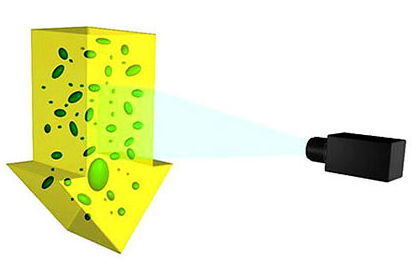
In Dynamic Image Analysis, a stream of particles is generated which is recorded and analyzed by a camera system. The particles are therefore in motion during the image acquisition. In most cases, Dynamic Image Analysis involves illuminating the particle stream from one side by a light source and recording the particle images as shadow projections. The particles move either in free fall (in the case of free-flowing, pourable granules), in a liquid or in an air stream, which ensures particle separation even for agglomerated powders.
Especially the last setup requires short exposure times and high acquisition rates to achieve sufficient particle detections during the measurement and to prevent motion blur. A particle measurement typically takes 1-5 minutes and usually detects tens of thousands to many millions of particles, depending on the sample.
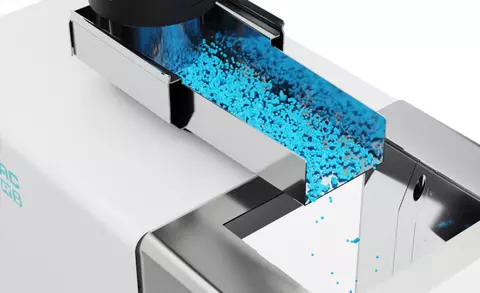
Dynamische Beeld Analyse - Principe
TEST The difference between Static and Dynamic Image Analysis
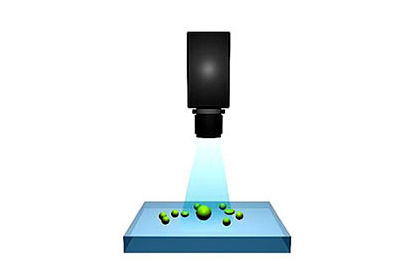
The crucial difference between Static and Dynamic Image Analysis is that in Static Image Analysis particles are located on a carrier and do not move relative to the camera during the acquisition, such as with a microscope.
Static Image Analysis is predominantly used for measuring narrow size distributions with a focus on the characterization of very fine particles. This method provides high resolution particle images which allow for size and shape description with utmost accuracy and is mainly used in research & development applications.
Dynamic Image Analysis on the other hand is ideally suited for routine measurements of bulk goods, powders, granules and suspensions. This method is characterized by high sample throughput, reliability and excellent reproducibility.
Statische Beeld Analyse (ISO 13322-1)
Dynamische Beeld Analyse (ISO 13322-2)
TEST Measurement range and calibration of a Dynamic Image Analysis system
The reproduction scale of a Dynamic Image Analysis system is determined by calibration. For this purpose, high-precision reference objects are inserted into the device and measured by the cameras.
This results in the imaging scale in pixels / millimeters and determines the resolution and detection limit of the measuring system.
The reference objects are usually glass plates to which defined circular elements have been applied by means of electron lithography. The calibration is done at the factory but can be repeated and checked by the user at any time in only 1-2 minutes.
The upper limit of the measuring range is limited by the image size. Particles up to approx. 1/3 of the image diagonal can still be reasonably detected with Dynamic Image Analysis.
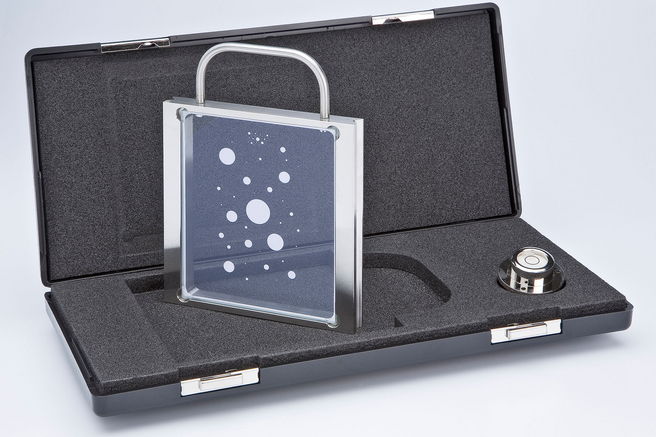
Calibratie glasplaat voor een Microtrac CAMSIZER systeem
TEST Dubbele-cameratechnologie in dynamische beeldanalysatoren
Het gelijktijdige gebruik van twee camera's in één analyzer breidt het meetbereik van Dynamic Image Analysis aanzienlijk uit. De twee camera's van de deeltjesanalysers van de CAMSIZER-serie zijn geoptimaliseerd voor verschillende groottebereiken: de ZOOM-camera registreert kleine deeltjes met grote nauwkeurigheid dankzij de hoge resolutie, terwijl de BASIC-camera tegelijkertijd grote deeltjes analyseert met een groter gezichtsveld.
Dit biedt ideale meetomstandigheden voor elk groottebereik. Het totaalresultaat wordt verkregen door de ZOOM- en BASIC-camera's te combineren.
Het grote voordeel van deze methode van Dynamische Beeldanalyse is een groot dynamisch meetbereik met een factor tot 10 000 tussen de onder- en bovengrens, en dit zonder aanpassingen aan de optische componenten (geen verwisseling van lenzen of objectieven).
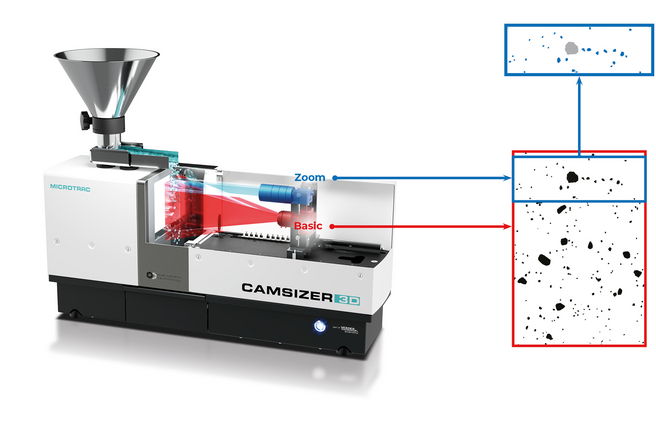
Twee camera's werken tijdens de meting: de BASIC-camera (rood) analyseert de grotere deeltjes, de ZOOM-camera (blauw) capteert de kleine deeltjes. Deze procedure zorgt voor optimale meetomstandigheden voor alle deeltjesgroottes in een distributie.
TEST Particle size and shape with dynamic image analysis
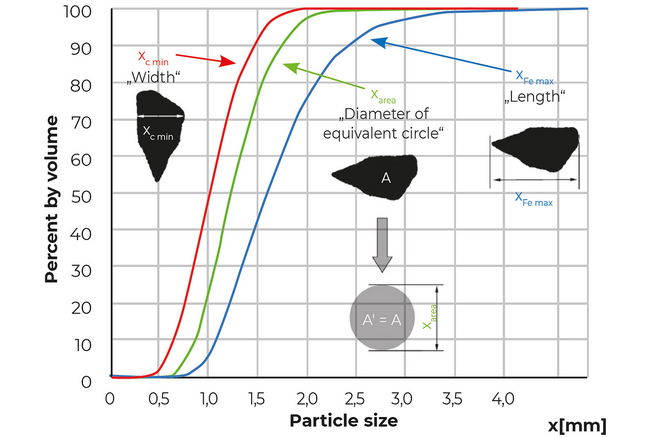
With Dynamic Image Analysis, many different morphological parameters can be recorded and quantitatively evaluated for all detected particles. The particle size distribution can be based on different size definitions, such as particle width, particle length or diameter of the equal area circle.
The sizes are determined, for example, as chord dimensions, Feret lengths or Martin diameters. Dynamic Image Analysis can also be used for a particle shape analysis, e.g. to characterize parameters like as roundness, circularity, aspect ratio, convexity, symmetry, and many more.
TEST Further advantages of dynamic image analysis
MICROTRAC Producten & Contact
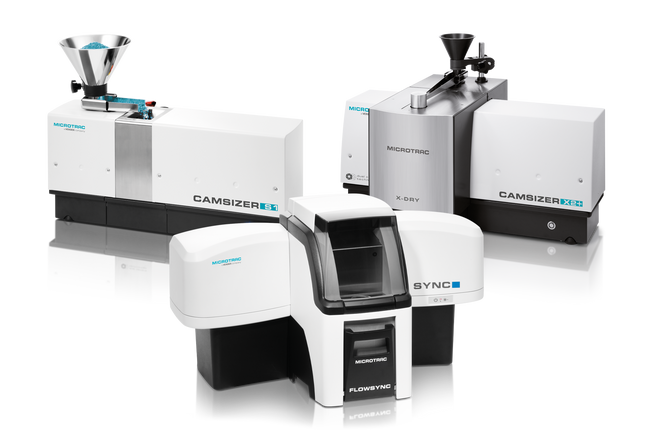
Microtrac offers a wide range of instruments for Dynamic Image Analysis.

Ons team van experts adviseert u graag over uw toepassing en over ons productgamma.
TEST Dynamic Image Analysis (DIA) - FAQ
What is the difference between Static and Dynamic Image Analysis?
In Static Image Analysis (SIA, ISO 13322-1), particles are at rest when images are recorded, as with a microscope. In Dynamic Image Analysis (DIA, ISO 13322-2), a stream of particles is captured by a camera system. The Static method produces detailed images of a few particles, whereas Dynamic Image Analysis can evaluate many particles in very short time. As a result, repeatability and detection probability of oversize particles are significantly better with Dynamic Image Analysis.
Can dynamic image analysis replace sieve analysis?
A major advantage of Dynamic Image Analysis is the compatibility of the results with those of traditional sieve analysis. Users benefit from the shorter measuring time and thus higher sample throughput, a high level of automation (e.g. online measurement) and lower susceptibility to human errors. The time-consuming weighing and cleaning of sieves is no longer necessary with Dynamic Image Analysis.
What is the measuring range of dynamic image analysis?
The lower measuring range for Dynamic Image Analysis is ~0.8 µm, the largest detectable particles are ~135 mm. The lower limit of each Dynamic Image Analysis system is limited by the resolution of the cameras, the upper limit by the size of the field of view (approx. 1/3 of the image diagonal). By using two cameras in one instrument, analyzers can achieve measurement ranges with a factor up to 10.000 between lower and upper limits.
Which samples are suitable for dynamic image analysis?
Dynamic Image Analysis is suitable for a wide range of different applications. It is used for routine quality control and production monitoring as well as for R&D tasks. Many industries are already taking advantage of the benefits of Dynamic Image Analysis. e. g. for pharmaceutical products, food, fertilizers, sand, building materials, plastics and wherever people are working with powdery or granulated products.
How long does a measurement with dynamic image analysis take?
Thanks to the high image acquisition rate of Dynamic Image Analysis (60 - 320 images per second, depending on the device), a large number of particles are evaluated in a very short time. Thus, a meaningful result is obtained quickly. Typically, the measurement times for Dynamic Image Analysis are 1 -5 minutes. Since the measurement is contact-free, the cleaning and maintenance effort is very low.