






A Microtrac é uma empresa líder que desenvolve, fabrica e comercializa vários analisadores para a determinação de quantidades adsorvidas de gás e vapor, bem como de distribuição de área superficial de BET e distribuição de tamanho de poros. Os instrumentos medidores aplicam tecnologia de adsorção de gás para analisar materiais em pó tanto porosos como não-porosos. Os produtos Microtrac são utilizados em todo o mundo em pesquisa e desenvolvimento (P&D), bem como em controle de qualidade (CQ) e garantia de qualidade (GQ).
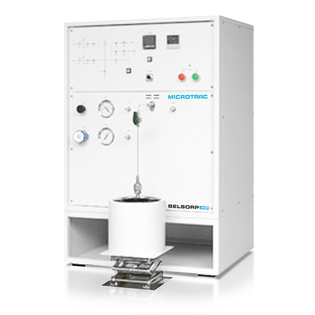
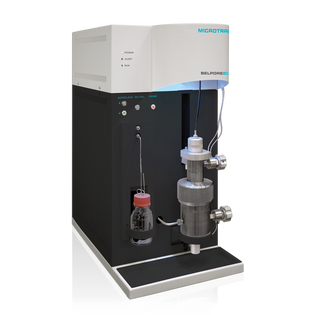
O que é adsorção?
The study of adsorption has quite a long history. The first document on adsorption is considered to be the study of adsorption behavior of charcoal by Fontana published in 1777. In 1814, N.T. Saussure did a lot of adsorption experiments onto charcoal. Now, his adsorption apparatus is exhibited in the National Historical Museum in England. Today's adsorption technology is widely used in the industrial process (e.g. gas and vapor separation) and for the characterization of fine materials.
An example of adsorption is visualized in the figure below. The figure shows the difference between chemisorption and physisorption. Generally, if the interaction between the adsorbate and adsorbent is strong (e.g. hydrogen bonding or acid-base adsorption), preventing desorption of the adsorbate by vacuuming at the given adsorption temperature or room temperature, it is called chemisorption. Physisorption, on the other hand, is the weak interaction mainly due to the van der Waals forces. The adsorbate can be easily desorbed by vacuuming. Recently, instead of using the terms "physisorption" and "chemisorption", "reversible" and "irreversible" adsorption have come into use.

Adsorption state
Gas adsorption is a fundamental analytical technique for evaluating the surface characteristics and internal structure of solid materials. Used across industries such as catalysis, pharmaceuticals, energy storage, and environmental engineering, gas adsorption reveals critical data on surface area, pore size distribution and porosity - key factors in performance and functionality.
Microtrac offers advanced gas adsorption analyzers and adsorption equipment designed to deliver precise, reproducible measurements that comply with international standards such as ISO 9277 and ISO 15901-2. Our instruments serve both R&D and quality control applications, enabling users to better understand and optimize materials.
Learn more about our full range of gas adsorption measurement solutions.
Why Gas Adsorption?
Gas adsorption involves the adherence of gas molecules onto the surface of a solid. This physical interaction, known as physisorption, forms the basis for characterizing materials with porous or high surface-area structures. By studying how much gas is adsorbed at different pressures, engineers and researchers can derive:
- Specific surface area (via BET method and more)
- Pore size distribution (via classical methods like BJH, or novel methods like GCMC or DFT models)
- Total pore volume
These metrics are vital across multiple applications:
- In adsorbents like activated carbon, surface area correlates with adsorption capacity
- In catalysis, higher surface area typically means more active sites for chemical reactions
- In batteries and fuel cells, pore volume and structure influence energy density and ion transport
- In pharmaceuticals, particle surface area affects dissolution rate and bioavailability
Industries in Gas Adsorption Analysis
Catalysis & Petrochemical Engineering

Catalyst efficiency depends heavily on surface area and accessible porosity. Gas adsorption analyzers help quantify the effectiveness of catalyst supports such as alumina, zeolites, and activated carbons. Accurate BET surface area measurements allows quality control, optimization of chemical reactors and extend catalyst life.
Pharmaceuticals

Regulated by compendia such as USP <846>, surface area analysis in drug substances is essential for controlling product behavior. Gas adsorption provides the data needed for consistent release profiles, bioavailability, and tablet performance.
Energy Storage & Conversion

Battery electrodes, supercapacitors, and hydrogen storage materials require a balance between surface area and pore accessibility. Gas adsorption is key to evaluating materials like porous carbons and metal-organic frameworks (MOFs) for optimal charge/discharge efficiency.
Environmental Technologies

Gas adsorption measurements are used to develop materials that capture or separate gases—such as CO2 or VOCs. From indoor air purifiers to industrial scrubbers, adsorbent performance is driven by total gas uptake, surface area and pore structure analysis.
Construction and Advanced Materials

In construction, ceramics, and filtration media, porosity affects strength, durability, and fluid permeability. Gas adsorption techniques are used to characterize materials such as aerogels, mortars, and porous ceramics, which are applied in both structural and thermal contexts.
Core Technique: Volumetric Gas Adsorption
Core Technique: Volumetric Gas Adsorption
The most usual form of gas adsorption measurement is volumetric (manometric) physisorption. This method involves dosing a known volume of adsorptive gas (typically nitrogen or argon) into an evacuated sample cell and monitoring pressure changes as the gas adsorbs onto the sample's surface. The resulting adsorption isotherm—gas volume adsorbed vs. relative pressure (P/P0)—forms the basis for analytical models.
Key steps:
- Degassing (Outgassing): Prior to analysis, samples are heated under vacuum to remove moisture and contaminants.
- Cryogenic cooling: Most measurements use liquid nitrogen (77 K) or liquid argon (87 K) to maintain stable, low temperatures ideal for physisorption.
- Equilibrium dosing: Gas is introduced incrementally until equilibrium is reached at each pressure step.
Microtrac's instruments support full automation of these steps with integrated degassing stations and precision dosing systems.

Standard Models for Data Analysis
BET Theory (ISO 9277)
The Brunauer–Emmett–Teller (BET) method is the gold standard for calculating specific surface area. It assumes multilayer adsorption and is applied to the linear region of the isotherm (typically P/P0 = 0.05–0.30; except type I isotherm). BET surface area is calculated from the monolayer capacity using:
- Molecular cross-sectional area of the adsorbate (e.g. 0.162 nm² for N2)
- Avogadro’s number
- Ideal gas law constants (such us molar volume of gas at STP)
Microtrac systems support both single-point and multi-point BET analysis as per ISO 9277 and ASTM D6556.
BJH Method (ISO 15901-2)
The Barrett–Joyner–Halenda (BJH) method is used to determine mesopore size distribution by analyzing the desorption branch of the isotherm. BJH applies the Kelvin equation to correlate pressure changes with pore diameters, assuming cylindrical pore geometry.
Ideal for:
- Silica gels
- Porous glass
- Mesoporous oxides
DFT, NLDFT & QSDFT
Density Functional Theory (DFT), non-local DFT (NLDFT), and quenched solid DFT (QSDFT) are advanced methods that model gas adsorption in porous materials based on statistical mechanics. Unlike BJH, which relies on certain assumptions about pore geometry and is limited in analyzing micropores, DFT-based methods can accurately account for a range of pore shapes and sizes, making them ideal for characterizing microporous materials such as activated carbon and metal-organic frameworks (MOFs).
- Provides high-resolution pore size distributions
- Applicable to a range of adsorbates and pore geometries
- Built-in libraries in Microtrac software enhance accuracy
Choice of Adsorbate Gases
The selection of gas affects sensitivity and pore accessibility:
- Nitrogen (N2, 77 K): Standard for BET and mesopore analysis. Well-characterized and widely accepted.
- Argon (Ar, 87 K): Preferred for micropore analysis due to its non-polar nature and smoother adsorption behavior.
- Krypton (Kr, 77 K): Used for low surface area materials (<1 m²/g). Its low saturation pressure increases sensitivity for small sample surfaces.
- Carbon Dioxide (CO2, 273 K or 298 K): Ideal for probing ultra-micropores (<0.7 nm), which are often inaccessible to nitrogen at 77 K due to kinetic restrictions and slower diffusion rates.
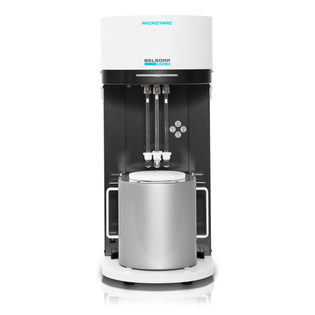
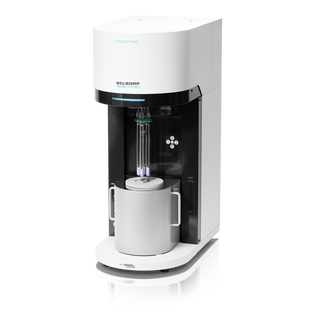
Microtrac’s BELSORP series supports all of these gases, enabling flexible, accurate analysis across materials.

Microtrac Gas Adsorption Analyzers: Engineered for Precision
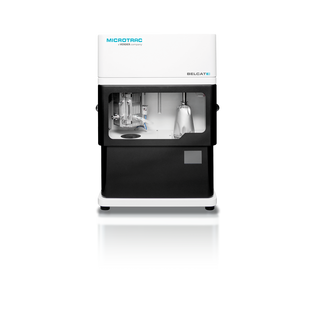
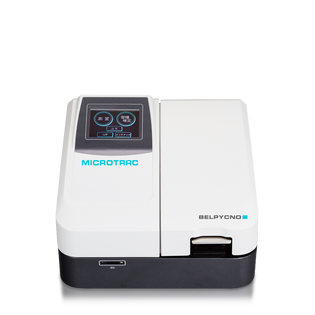
Microtrac’s portfolio of gas adsorption analyzers is designed to deliver maximum reliability, compliance, and ease of use. Key features include:
Conclusion: Precise Gas Adsorption Measurement for Confident Material Design
Gas adsorption is not just a laboratory technique - it is a gateway to understanding how materials behave in real-world applications. Accurate surface area and porosity data can inform:
- Material selection
- Product formulation
- Regulatory approval
- Performance optimization
Microtrac’s gas adsorption analyzers empower users to obtain this information quickly, reliably, and in full compliance with international standards. Whether you're testing catalysts, refining pharmaceutical powders, or exploring next-generation adsorbents, we have the adsorption equipment to support your goals.
Learn more about our Gas Adsorption Measurement instruments and how we can help you bring material innovation to life.
Análise dinâmica de imagens - FAQ
What is gas adsorption used for?
Gas adsorption is used to determine surface area, pore size distribution, and gas-solid interactions. It is essential for industries like catalysis, energy, and pharmaceuticals.
What is the difference between physisorption and chemisorption?
Physisorption involves weak van der Waals forces and is reversible, while chemisorption involves stronger chemical bonds and is often irreversible. Both are studied using gas adsorption methods.
How do gas adsorption analyzers work?
Gas adsorption analyzers measure the quantity of gas adsorbed on a solid material at varying pressures. This data is used to calculate surface area and porosity using models such as BET or BJH.
What gases are commonly used in gas adsorption?
Nitrogen is the most common gas due to its inertness and consistency. Other gases like argon, CO2, or krypton may be used for specific materials and applications.